09 / 15 PROJECT
Every projectMobile Based Offline AI App
A phone app that runs distilled models on the handset itself, with offline maps and survival guides alongside them. Built for places with no signal, and still in progress.
- GGUF
- quantised model format
- llama.cpp
- on-device runtime
- July 2025
- dated, still in progress
Inference with no network
The app carries the model rather than a connection. Quantised GGUF models run on the device, with llama.cpp in the stack, so inference does not depend on a cloud call. The runtime is written to be memory aware and battery aware, and those two constraints decide the rest: a phone will not hold a large model, and a model that empties the battery is no use where the app is meant to be used.
What else it carries
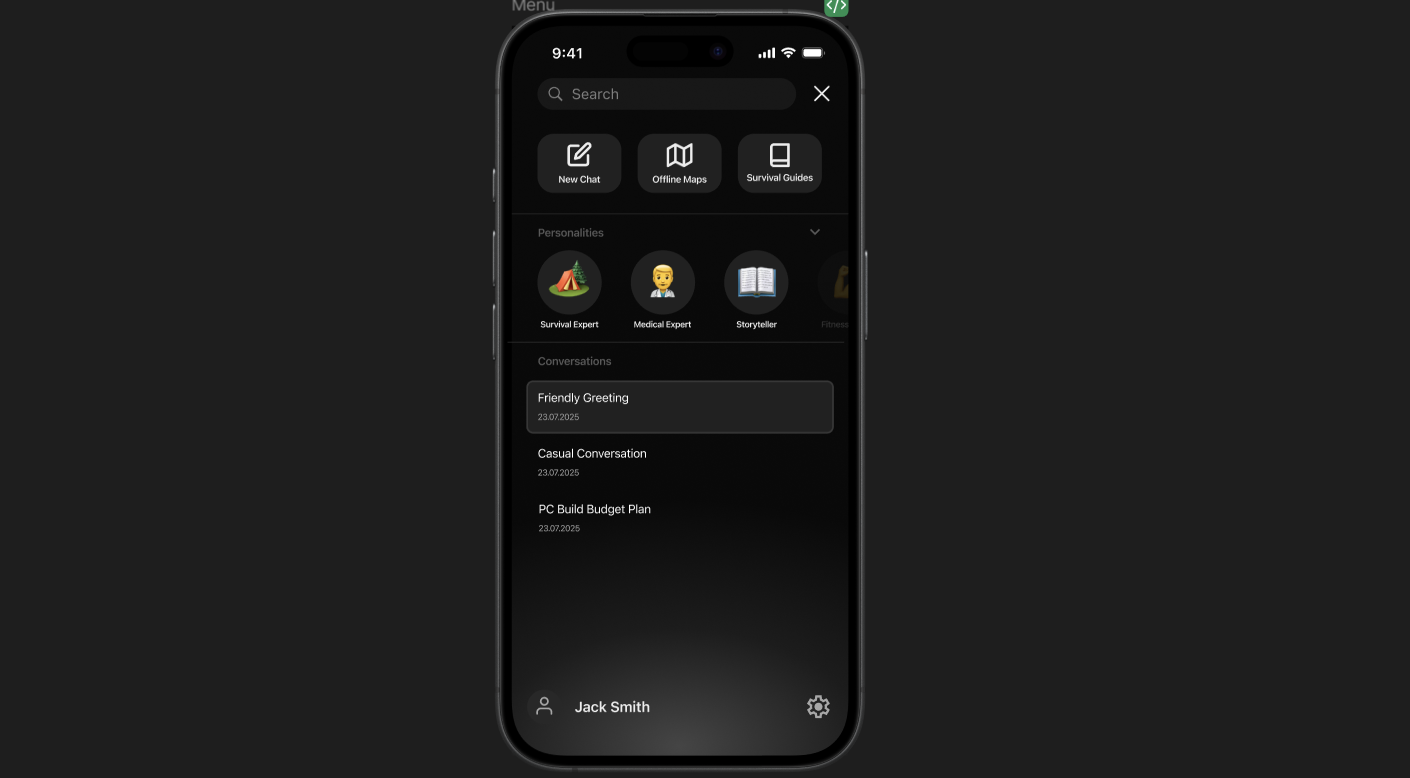
The menu opens on new chat, offline maps and survival guides, with a row of personalities above the saved conversations: survival expert, medical expert, storyteller. They are system profiles, so the same local model can be pointed at different jobs. A local vector store gives it semantic recall. The stack listed against the project is Flask, Python, SQLite, llama.cpp and GGUF, with Swift, Figma, React and Next.js.
The app carries the model rather than a connection.
Still in progress
The project is marked in progress and dated July 2025. It sits in a longer line of local inference work: MotionGen runs its models entirely locally inside the Unity editor, and what I am actually aiming at is private, local AI tools for individuals and businesses.
What it does
- 01Fully offline inference (no cloud dependency)
- 02Multiple AI personalities / system profiles
- 03Local vector store & semantic recall
- 04Offline maps & survival reference modules
- 05Optimized quantized GGUF models (memory aware)
- 06Energy adaptive runtime (battery aware)
Built with
- AI
- LLM
- Flask
- Python
- LLama.cpp
- SQLite
- GGUF
- Swift
- Figma
- React
- Next.js